
What is VFD?
Variable Frequency Drive, abbreviated as VFD, is a motor controller that rotates the electric motor by changing the frequency and voltage applied to it. Other names of VFD are variable speed drive, adjustable speed drive, adjustable frequency drive, AC drive, Microdrive, and inverter. Frequency (Hz) is directly related to motor speed (RPM). In other words, more frequency makes the engine spin faster and increases RPM. If an application does not require the motor to run at its full rated speed, the VFD can be used to reduce the frequency and voltage to match the load requirements of the electric motor. If the user's speed needs to change, the VFD can easily adjust the engine to this requirement by increasing or decreasing the motor speed.
Variable-frequency drives are used in various applications from small appliances to large compressors. About 25% of the world's electrical energy is consumed by electric motors in industrial applications. Systems that use VFDs can also use systems with pumps or fans. However, global market penetration is relatively small for all VFD applications. Over the past four decades, power electronics technology has reduced the cost and size of VFDs and improved their performance with advances in semiconductor switching devices, drive topology, simulation techniques, and hardware and software control.
VFDs are manufactured in a number of different low and medium-voltage AC-AC and DC-AC topologies and categorized as a part of the motors and motion control groups from industrial automation.
How does a VFD work?
The first stage of the variable frequency AC drive, or VFD, is the converter. The converter includes 6 diodes which act like a one-way valve in piping systems. These diodes allow current to flow in only one direction, indicated by the arrow on the diode symbol. For example, when the voltage of phase A (the same voltage as the pressure in piping systems) is more positive than the voltage of phases B or C, then its diode opens and current is established.
Whether your customers are residential, commercial, or industrial; whether you create custom automation and integration solutions or manufacture products that require 21st-century control, Maple Systems will add value and improve your user experience.
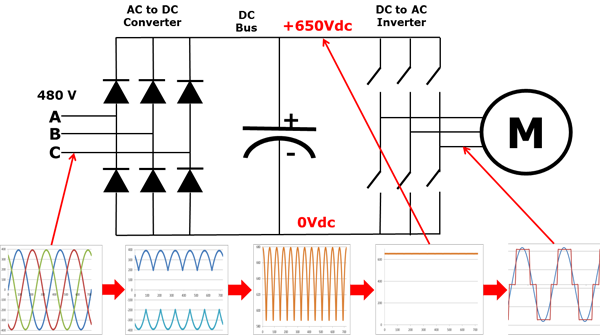
When phase B becomes more positive than phase A, then the diode of phase B will open, and phase a will close. This issue is true for the diodes that are in the negative part of the bass. Thus, we have 6 current pulses by turning off and on each diode. This method is called a six-pulse VFD, which is the standard combination for current variable frequency drives.
For example, let's assume that the drive works in a 480V power system. 480V is the effective voltage (RMS). The peak voltage in a 480V system is 679 volts. As you can see, the dc bus of the variable frequency drive has a dc voltage with an ac ripple. The voltage fluctuates between 580V and 680V.
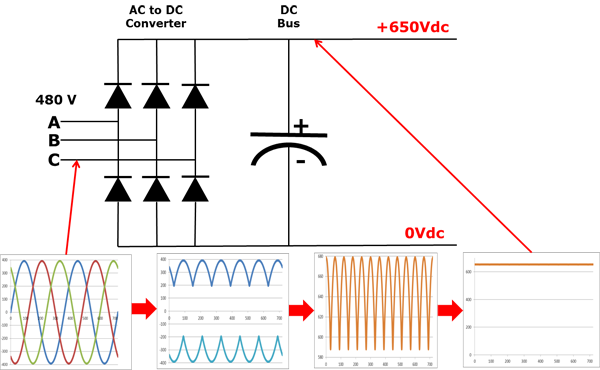
You can get rid of AC ripple by adding a capacitor to the DC bus. A condenser acts like a tank or a reservoir in a piping system. This capacitor absorbs the AC ripple and delivers a smooth voltage. AC ripple on the DC bus is typically less than 3 volts. Therefore, the voltage on the DC bus becomes approximately 650VDC. The actual voltage depends on factors such as the voltage level of the AC line feeding the drive, the level of voltage unbalance on the power system, the motor load, the impedance of the power system, and any reactors or harmonic filters placed on the drive. has it. Diode bridge converter that converts AC voltage to DC.
Sometimes known simply as a converter. A converter that converts DC voltage to AC voltage is also a converter, but to distinguish it from a diode converter, it is known as an inverter. It is common in the industry that any converter that converts DC to AC is known as an inverter. The current in the inverter is known.
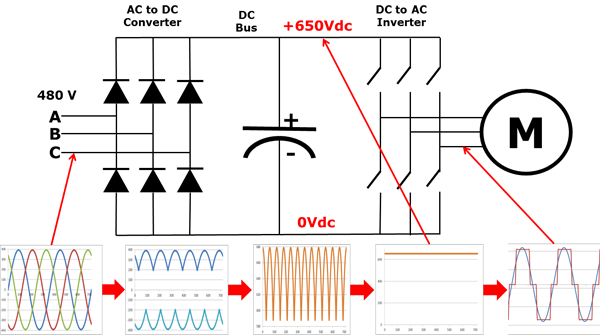
Current in the Inverter Note that in a real VFD, the switches shown are transistors in action. When we close one of the upper switches of the inverter. A phase of the motor that is connected to it is connected to the positive of the DC bus and the positive voltage falls on that phase. And when we close one of the lower keys in the inverter.
The phase is connected to the negative of the dc bus and its voltage becomes negative. In this way, we can make any phase we want positive or negative and thus produce our desired frequency. We can make each phase positive, negative, or zero.
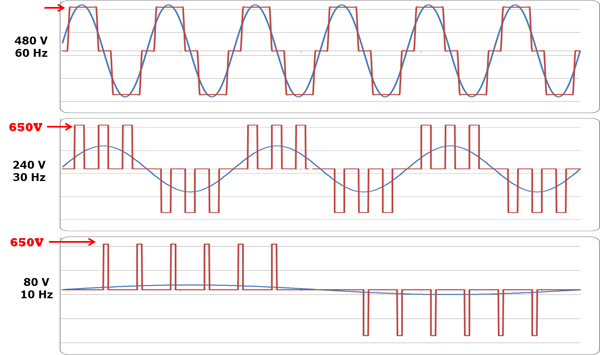
The blue sine wave is shown for comparison only. The drive does not generate this sine wave in real mode. Note that the output from the VFD is a rectangular waveform. VFDs do not produce a sinusoidal output. This square waveform is not a good choice for a power distribution system but is perfectly fine for engine use. If we want to reduce the motor frequency to 30Hz, then we simply switch the inverter output much slower. But, if we reduce the frequency to 30Hz, then in order to keep the V/Hz ratio constant, we need to reduce the voltage to 240V. (See Fixed V/F Drive Theory). How are we going to reduce the voltage when the only voltage we have is the 650VDC bus voltage? This is called pulse width modulation. Imagine if we could control the water pressure of the track by opening and closing the existing valve very quickly. While this would not be practical to do in piping systems, it works well with VFDs. Note that during the first half cycle, we have voltage at the output in half of the times of one cycle and no voltage in the other half cycle. Therefore, the average output voltage of 240V is equivalent to half of the 480V supply bus voltage. By controlling the output pulses, we can create any average voltage we want on the VFD output.
What is a VFD controller?
The operator interface provides a means to start and stop the motor and adjust the operating speed. The VFD may also be controlled by a programmable logic controller via Modbus or other similar interfaces. Additional operator control functions may include reversing and switching between manual speed adjustment and automatic control from an external process control signal. The operator interface often includes an alphabetic display or indicator lights and meters to provide information about drive performance.
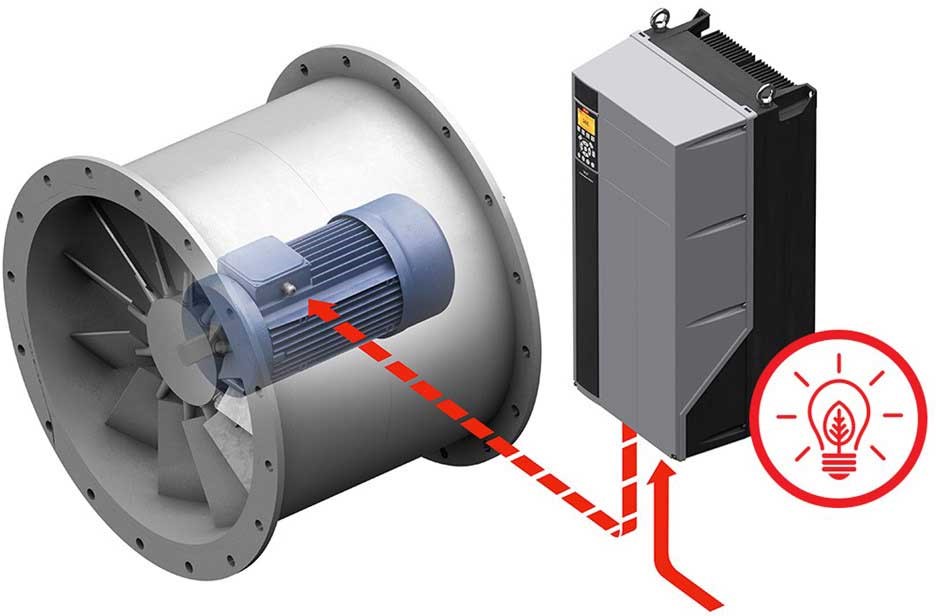
Different types of variable frequency drives
There are other types of VFDs on the market, depending on how AC power is converted to DC power with a VFD and its rectification. The three main types of VFD are VSI and CSI and PWM.
VCI
VSI stands for Voltage-source inverter. This is the most common type of variable-frequency drive (VFD). In this type of VFD, a simple diode bridge is used to convert the AC signal (alternating current) to the DC signal (direct current) and a capacitor is used to store energy. The switching circuit of the inverter uses the energy stored in the capacitor and supplies the output.
VCI at a glance:
| Advantages | Disadvantages |
| Has a good speed range | Due to the effect of cogging torque, the motor load oscillates during start and stop |
| The possibilities of engine control are multiple. Multiple motors can be connected with VFD-type VSI | The output produces various types of harmonics and noise |
| Simple design | If the speed of the motor is controlled or reduced, the overall power factor will be disturbed to a great extent, leading to a weakening of the power factor |
| Cost-effective in terms of production and installation | Due to the effect of cogging torque, the motor load oscillates during start and stop |
CSI stands for current source inverter. The VSI type of VFD is designed in such a way that it can provide a uniform voltage depending on the variable frequency range, but in the CSI type of VFD, the structure is dependent on current instead of voltage. Also, in the case of CSI, a thyristor bridge converter (SCR) is used instead of the diode bridge rectifier. The output power is filtered by using series inductors instead of capacitors for smooth current output. The CSI type of VFDs operates like a constant current generator. Instead of a square wave of voltage, the CSI type of VFDs are capable of providing a square wave of current.
CSI at a glance:
| Advantages | Disadvantages |
| VSI type of VFD is reliable | Overall power factor is poor, especially at low RPM |
| Supports higher horsepower induction motors as VSI is not a good choice | There is Cogging effect and it can capture the vibration of the motor axis during operation |
| Simple design, Good restoration | In terms of VSI, it is not suitable for multi-engine operations |
It is an improved and modified version of the VSI VFD type. PWM stands for pulse width modulation. By using the PWM technique, VFDs are able to provide stable voltage with a frequency ratio. The construction uses a diode bridge to rectify the AC signal into a DC signal. The switching circuit controls the duty cycle over a variable frequency range. An additional regulator is used to adjust the PWM output to provide a stable and appropriate voltage and current to the load.
PWM at a glance:
| Advantages | Disadvantages |
| No clogging or jarring effect | Sophisticated design |
| Includes different types of protection circuits | Requires additional hardware |
| Includes power factor | Generating expressive noise in the driver circui |
| Creating very high efficiency | Expensive solution |
| Energy efficient |
Variable frequency drive is used in what industries?
Variable frequency drive products are now used in industries such as mining, steel, air conditioning, textile, paper making, chemical, etc., in applications such as pumps and fans, cranes, mixers, extrude, etc.
What is the reason for using VFD?
Saving costs and reducing energy consumption
One of the best features of VFD is reducing costs and energy consumption. If your device doesn't need to run at full speed, it's in the best position to significantly reduce your energy costs.
To do this, it is enough to reduce energy costs by controlling the motor with a VFD. This item can be very profitable and useful for you. A variable frequency drive or VFD helps you adjust the speed of the rotating parts connected to your machine's motor according to your needs. Note that you will not have another way to do this process.
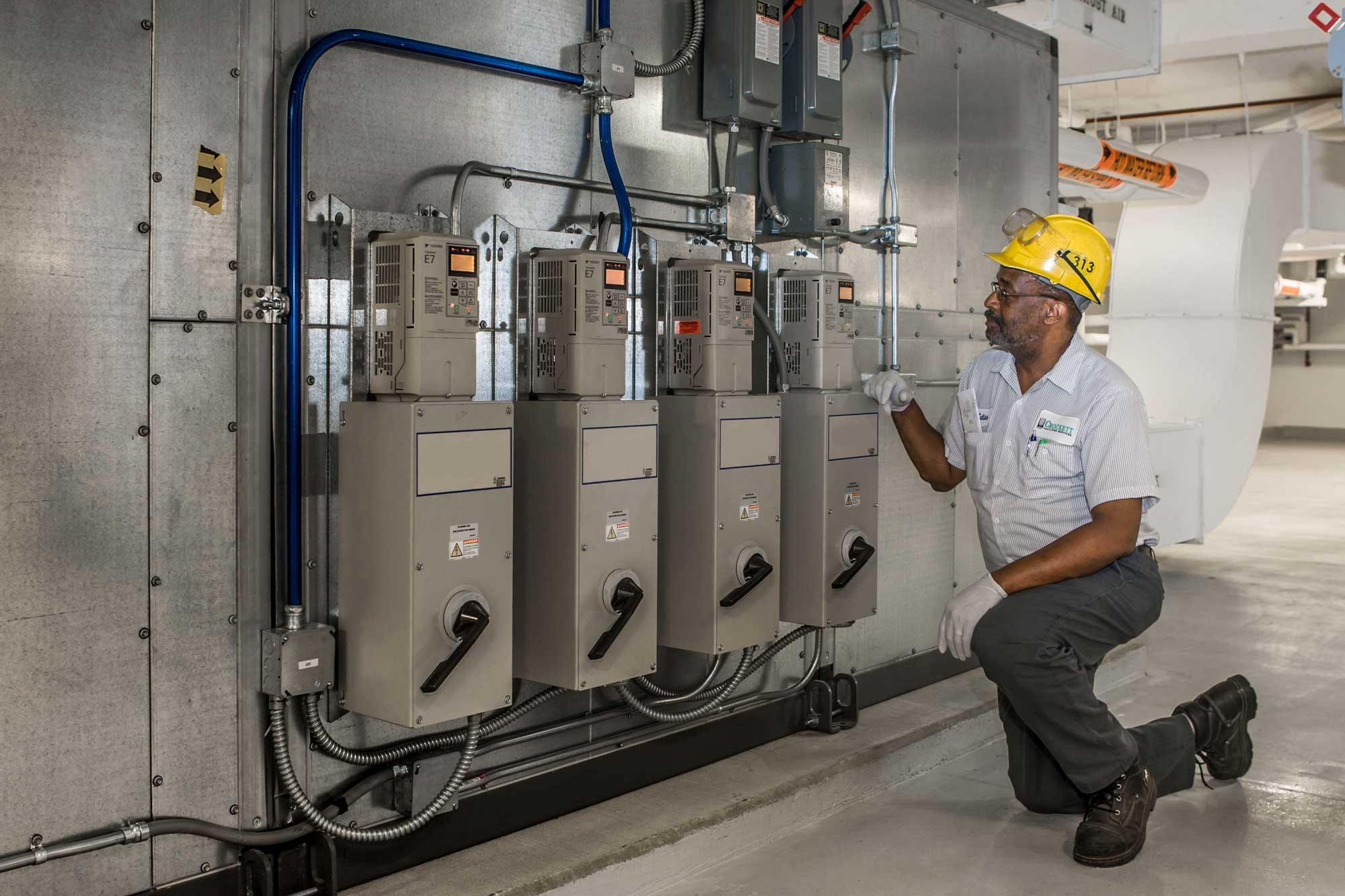
At present, more than 65% of the power consumption of the network is related to the use of electric motors. We ensure that by optimizing the motor control system by means of VFD, you will reduce the energy consumption of your facility by about 70%. In addition, the use of VFDs increases product quality and reduces product production costs. The combination of tax incentives related to energy consumption reduction and electricity company discounts can cause a very short 6-month return on investment.
Strict control over the production of products and its increase
By operating the engine at the best speed for your required application, the number of mistakes will be reduced to the optimum level, and as a result, the amount of production of products will be accompanied by a significant increase. With this process, your company's income will increase. By installing conveyors and belts, the start-up shock is removed and the work process becomes faster. For example, in mining industries and large factories, by installing VFD on conveyors as well as conveyors and belts, the start-up operation will be eliminated and the speed of the work process will be increased.
Increasing parts life cycle and reducing the need for repairs and maintenance
If VFD is used, the life of the equipment is increased and the downtime of the device for repairs and maintenance is reduced. When motors are controlled with VFD, the optimum motor speed is ensured. Because VFDs control voltage and frequency optimally, VFDs provide better motor protection in cases such as electrical thermal overloads, phase protection, Overvoltage or Undervoltage, etc. If the motor is started using a VFD, the motor or rotating load will not be exposed to a momentary shock of direct starting with the line voltage. And it starts up smoothly and very slowly, and therefore the wear of the gearbox and belts is eliminated. It is also a very convenient way to reduce the impact of the ram (as it is called). Because it can have very smooth acceleration and deceleration cycles.