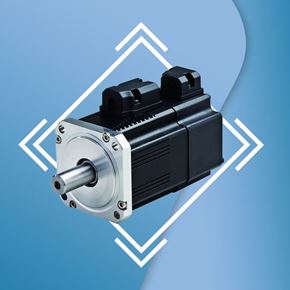

A servo motor is the muscle of a control system. This muscle, suitable for various applications, provides the necessary force to move factory equipment. Many people think that a server is a tool used separately, But a servo motor cannot be used alone and without a set of devices that are put together to achieve a specific goal.
An electric motor is a device that converts electrical energy into mechanical power. In most electric motors, this mechanical force is a rotational force. This rotational force can be used to perform various tasks. Among the applications of electric motors, we can mention drilling, stone cutters, conveyors, fans, pumps, robots, etc.
Working principles of servo motors
The first principle
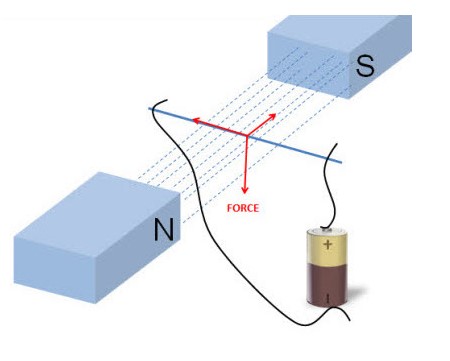
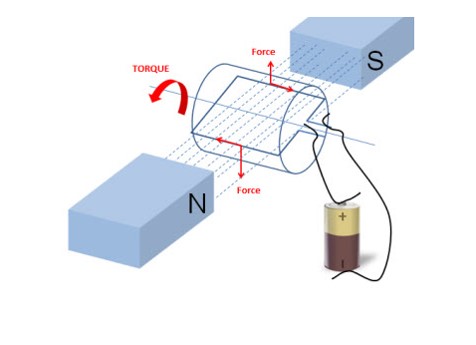
When a wire carrying an electric current is placed in a magnetic field, a force causes the wire to rotate. The direction of this applied force is perpendicular both to the field lines and to the direction of the current flux. (The flux of the magnetic field is from N to S and the current direction is from the positive side of the battery to the negative side of the battery. The order of the applied force is obtained by using the rule of the right hand. When the four fingers of the right hand are in the direction of the current and the magnetic field is from the palm out, the direction of your thumb is the direction of the force on the string.
The second principle
Here, we see a loop of wire (motor rotor) that can rotate freely. As we read in the first principle, the current passing through the rotor and the existence of the magnetic field introduces a force to the rotor. If you look carefully, the force acting on one side is upward and the force acting on the other side is downward.
As a result of the interaction of these forces, a torque is created and the wire loop (rotor) starts to rotate and the motor starts moving because of that.
The third principle
In order for the rotor to keep rotating, we must change the direction of the wire loop current after every half cycle.
This causes the direction of the force applied to the wire to be reversed in each half-cycle. An iron gap ring or commutator does this for us. If we change the current direction correctly and in time after each half-cycle, the rotor will continue to rotate and the motor will work without any steps.
What type of electric motor is a servo motor?
Now it's time to consider which model of engine is considered a servo engine.
A servo motor may be any of these models, provided that it is accompanied by a suitable drive, a suitable control, and a feedback system.
Industrial servo motors must be fast and accurate and able to produce high torques in their working conditions. Therefore, industrial servo motors are designed based on the design of brushless motors.
A motor is just a motor, but when combined with a suitable drive and encoder feedback, it acts as a servo.
Technology and performance of servo motors
Servo motors are one of the most essential pieces of equipment in the motion control system. For better performance and efficiency, we connect the servo motors to the motion control system both in terms of hardware and software. Servos are used in different parts of the factory and produce the necessary force to move objects.
Configuration of servo motor system
Servo motors are used in the motion control system to produce a specific mechanical force according to time. By controlling the servo motors and adjusting the position, speed, and torque, it becomes possible to achieve the goals we have in mind for different applications. In order for a servo motor to work properly, it should be used with the following items:
Controller: Usually, a PLC or a specific motion controller is used to run the motion control program in various applications.
Drive: An electronic device that provides the power required by the engine in the best way and at the right time.
Encoder: Encoder is used to get feedback from the motor condition.
What is the control ring in the servo motor?
The provision of control loops is such that by using a servo drive or motion controller or both of them (according to our application and the strategy we have in mind), we obtain information and access control loops and feedback. let's find
For position, speed, and torque, separate control loops are used to achieve our desired values according to the type of movement we have. Of course, we don't need all these control loops for all applications. In some applications, we only need the current loop to achieve the proper torque. Sometimes we need both the current loop and the speed loop to control the speed, and finally, for some applications, we need all three of these control loops to control the position.

Position control with servo motor
The position indicates the angular position of the servo motor shaft or in some cases the equipment connected to the motor shaft. When the servo motor is commanded to move to another position, the encoder sends the motor's current position to the servo drive or sometimes directly to the controller. The position loop compares the received value with the current state (through adjustment parameters and error detection in control loops) and the drive automatically adjusts the motor position to the desired state.
In fact, the servo motor does exactly what it is commanded to do, and if there is a change in position or For example, a load with more power is connected to the motor, with repeated feedback from the drive, it orders that less or more power is delivered to the servo and also has a calmer behavior to reach the desired state in order to deal with the increased resistance and an accident.
Speed control of servo motor (Velocity Control) with servo motor
Speed means the speed and direction of motor servo movement. When the servo motor is commanded to increase or decrease speed, the servo encoder sends a signal of the motor's current speed and direction to the servo drive.
The Velocity loop compares the received value with the current speed (through adjustment parameters and error detection in the control loops) and the drive automatically adjusts the motor speed to the desired value in real-time so that the program goes well.
The motor servo executes the received program and if changes are made in the system, for example, if a heavy load is connected to the motor, the speed control loop is passed again and the drive adjusts the conditions and sends new commands to bring the motor to the desired speed.
Read more: What is Servo Motor?
What is the braking energy of a servo motor?
You might be surprised to learn that servo motors can also generate electricity. If we move a servo motor with an external force (for example, turn it by hand), an electric current is induced in the stator. When a servo lifts equipment vertically, the servo is acting against gravity and requires more torque; But when it's lowering the gear, gravity helps the engine spin. In changing the position of the objects in the horizontal position, when the drive slows down the speed of a heavy load, the inertia of the load wants to fight this change of position and the motor remains in the same position.
This excess electrical energy, which is very high, must be absorbed or removed in some way. This energy is called regenerative energy or braking energy, and the servo drive is designed to absorb some of this energy. If this force is excessive, an external resistance brake should also be used to remove this energy as heat.