
HMI stands for Human Machine Interface and means communication between man and machine. From it to monitor and observe and adjust the parameters of industrial devices such as PLC, inverter, etc. used The touch panel is an LCD monitor that can be programmed. With its help, you can change various parameters and control the system.
Among the positive features of the touch screen, the following can be mentioned:
1) It occupies less space.
2) It has fewer moving parts.
Touch screen components
A touch sensor
It is a transparent glass frame with a touch-sensitive surface, and the way the touch frame is placed on the screen is such that the sensitive area of the frame overlaps with the visible part of the screen. The susceptible receiver generally has an electric current. That touch changes the signals in it. The voltage change is used to detect the touch location on the screen.
Controller
It is a small PC card that establishes the connection between the touch receiver and the computer. By receiving unique signals from the touch screen, it converts them into meaningful signals for the processor and transmits them to the computer through the USB or serial port.
Software driver
It specifies how to interpret the information received from the controller for the operating system. In all existing technologies, information is transferred from the sensitive receiver to the controller, and the controller converts them into meaningful signals for the computer, and the software drive specifies how to interpret the information sent from the controller.
Touchscreen manufacturing technologies
Depending on the application of systems equipped with a touch screen, there are different technologies, which we will discuss in order of their structure:
Touch screen with resistive structure
It consists of a glass frame covered with layers of conductive and resistive materials. These two layers are separated by invisible points. In normal conditions, there is no contact between the two layers of conductor and resistance,

and no current is transferred between them. When a touch happens, at that particular point two layers collide and cause a change in the amount of electric current passing. This change is discovered by the controller and with a little processing of the information obtained from the touch, it turns them into a horizontal and vertical coordinate and registers it as a touch event. The resistive type of touch screen is sensitive to any type of pressure and has a simple construction, but the resolution of the image they provide to users is lower than other types, this number is around 75%, and the resistance layers against sharp and pointed objects are vulnerable. This type of touch screen does not lose its effectiveness due to the presence of elements such as moisture and dust, and due to its low price, high accuracy, and accessibility, it is considered one of the most widely used technologies today.
Capacitive touch screen
It consists of a glass frame containing a capacitor that stores electric charge. When the screen is touched with a suitable conductive object such as a finger, some of the electric charges are transferred to the user,

and the electric charge on the capacitive element is reduced. This reduction is measured by the circuits located in the corners of the screen. The computer calculates the exact location of the touch from the relative changes of the load in each corner and sends the information to the software driver. In this technology, the touching object must be a conductor of electricity, such as a bare thumb, or a pen that is a conductor of electricity. Such touch screens are very resistant to factors such as moisture and dust, and the resolution of the image provided by them is excellent (about 90 percent), so they are used in various applications.
Infrared
It consists of a horizontal and vertical arrangement of infrared receivers. On one side there are light-emitting diodes and on the other side, there are several light-receiving sensors. When the touch event occurs, there is an interruption in receiving light in the touched place,
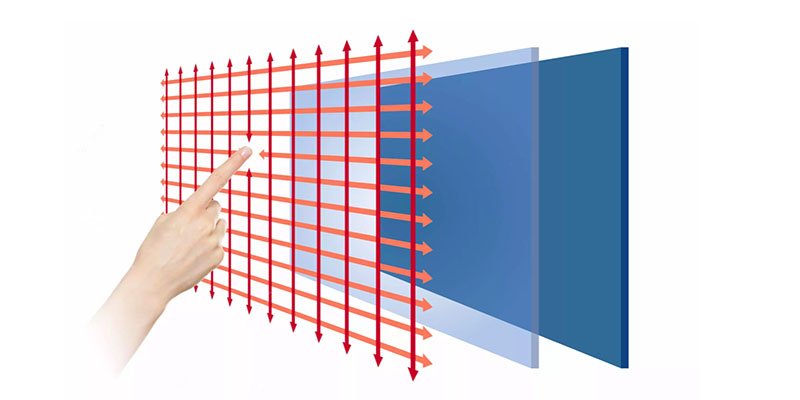
which happens if this change occurs in the receiving sensors to discover the coordinates of the touched place. Optical touch screens are resistant to the external environment in terms of longevity and stability, and their sensors only fail in case of physical damage, so in many military applications that require a touch screen, this technology is used to make the screen are benefiting
Touch screen (Surface Acoustic Wave (SWA)
It is one of the most advanced technologies of touch screen and it is very similar to optical types, but it uses sound waves instead of light rays. Two sound waves originate along the x and y axes and move on the screen, and on the opposite side, each wave is received by the receiver sensors.

When the screen is touched, the waves will be absorbed in the touched point and cause a delay in the reception of the wave by the receiver, which indicates the depth of the applied pressure. These types of touch screens, unlike other types, can detect the amount of pressure applied or the depth of the z-axis touched. This system does not have metal layers on the screen and allows 100% of light to pass through, resulting in an image with full clarity. Touch is detected by any device (except sharp and small devices such as automatic heads) but may be damaged by elements such as dust and moisture. SAW is considered the best option available for displaying high-detail images. This technology is widely used for information kiosks in crowded environments and the construction of educational computers.
Factors affecting the price of a touch monitor
• The size of all types of screens and their models can be administrative, educational, and advertising.
• The types of panels used in the structure of touch screens are different.
• The resolution size and aspect ratio of the images created by the touch monitor
• Features and types of connections used in the structure of the touchscreen

Read more: What is HMI and what is its application?
Does each touch screen (Touch Panel) have its special software?
Each panel and touch screen has its special software. But the programming method for all these is the same:
• Selecting pages and designing their graphics by selecting and changing graphic and non-graphic elements
• Defining the connection between the panel and the control system
• Defining the list of desired variables
• Making the elements in the pages dynamic (for example, assigning value tags to I/O Fields and assigning tags to graphic elements and defining the color change of elements by changing the state of the corresponding tag, assigning tags displaying analog values, etc.)
• Defining more facilities if necessary (such as defining the archive system, defining the reporting system, the alarm system, etc.)
Does the touch panel have input and output?
The industrial display itself is only responsible for displaying parameters for the operator and receiving values for him. And it usually does this through communication with an industrial controller (such as PLC). Inputs and outputs are on the controller and this controller communicates with the HMI by connecting through the network. Therefore, the industrial displays themselves do not have input and output. But if you see that somewhere an HMI has several inputs and outputs, know that this is not a single HMI. Rather, it is a set of PLC and HMI.